What Is AI Agent Engineering? A Complete Guide to Building Intelligent AI Agents
A chatbot waits for your question.
An automation waits for a predefined trigger.
An AI agent can take a goal, figure out what needs to happen, use the right tools, make decisions along the way, and take action.
That difference is changing how enterprises think about software.
Instead of building applications that only respond to instructions, organizations can build systems that can understand objectives, reason through tasks, interact with business systems, and complete multi-step workflows.
This is where AI Agent Engineering comes in.
What Is AI Agent Engineering?
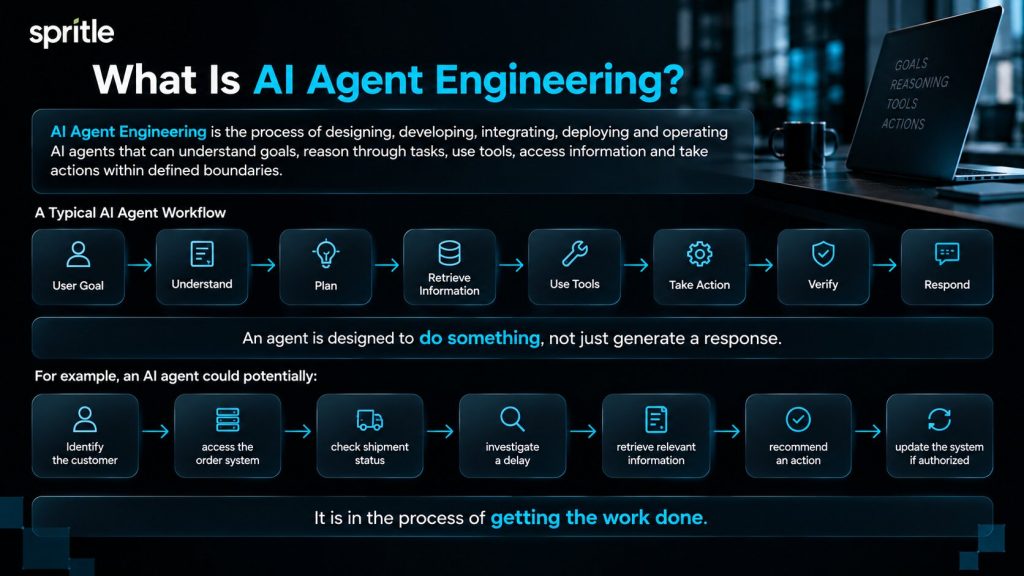
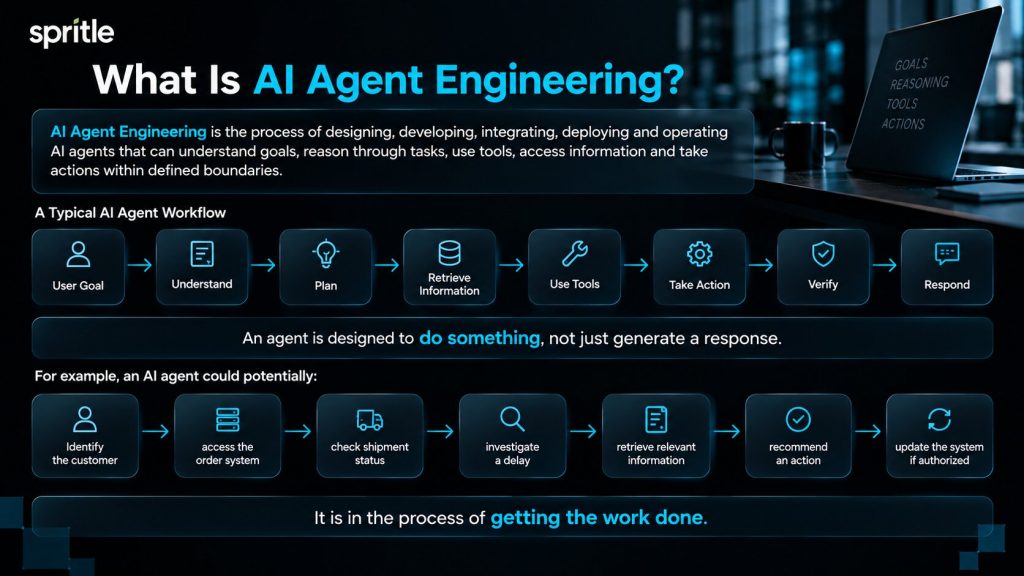
AI Agent Engineering is the process of designing, developing, integrating, deploying and operating AI agents that can understand goals, reason through tasks, use tools, access information and take actions within defined boundaries.
Unlike a simple AI chatbot, an agent is designed to do something, not just generate a response.
A typical interaction might look like:
User Goal → Understand → Plan → Retrieve Information → Use Tools → Take Action → Verify → Respond
For example, instead of asking an AI assistant:
“What is the status of this customer order?”
an AI agent could potentially:
Identify the customer → access the order system → check shipment status → investigate a delay → retrieve relevant information → recommend an action → update the system if authorized.
The intelligence is not just in the answer.
It is in the process of getting the work done.
AI Agent vs Chatbot: What’s the Difference?
This is one of the most important distinctions to understand.
A chatbot primarily focuses on conversation.
An AI agent focuses on goal completion.
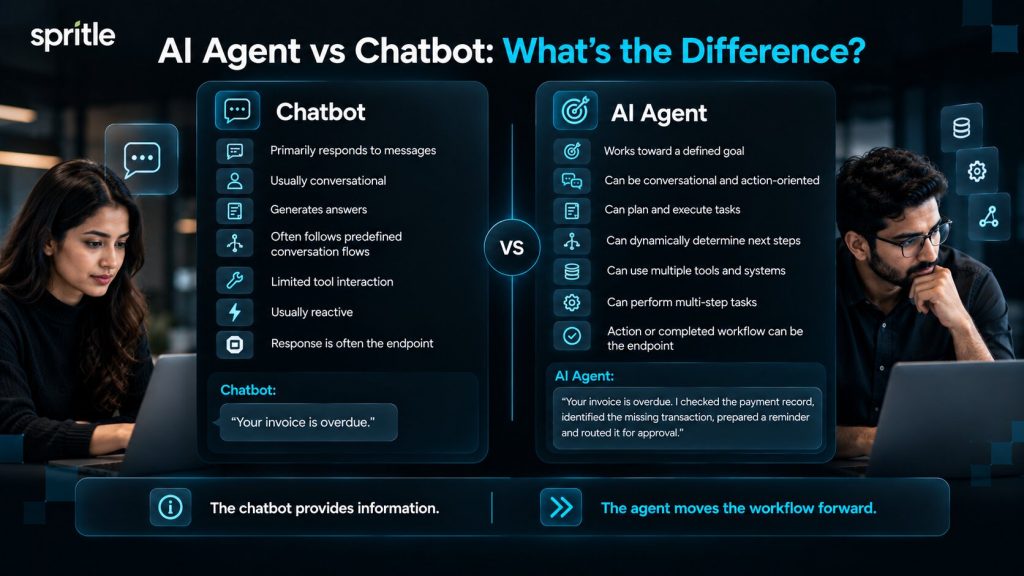
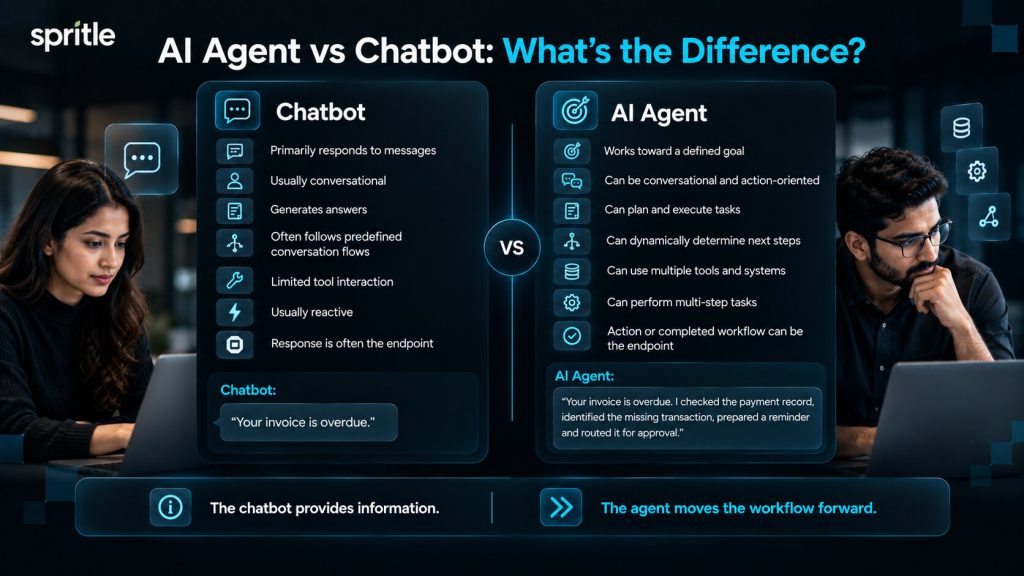
| Chatbot | AI Agent |
| Primarily responds to messages | Works toward a defined goal |
| Usually conversational | Can be conversational and action-oriented |
| Generates answers | Can plan and execute tasks |
| Often follows predefined conversation flows | Can dynamically determine next steps |
| Limited tool interaction | Can use multiple tools and systems |
| Usually reactive | Can perform multi-step tasks |
| Response is often the endpoint | Action or completed workflow can be the endpoint |
For example:
Chatbot:
“Your invoice is overdue.”AI Agent:
“Your invoice is overdue. I checked the payment record, identified the missing transaction, prepared a reminder and routed it for approval.”
The chatbot provides information.
The agent moves the workflow forward.
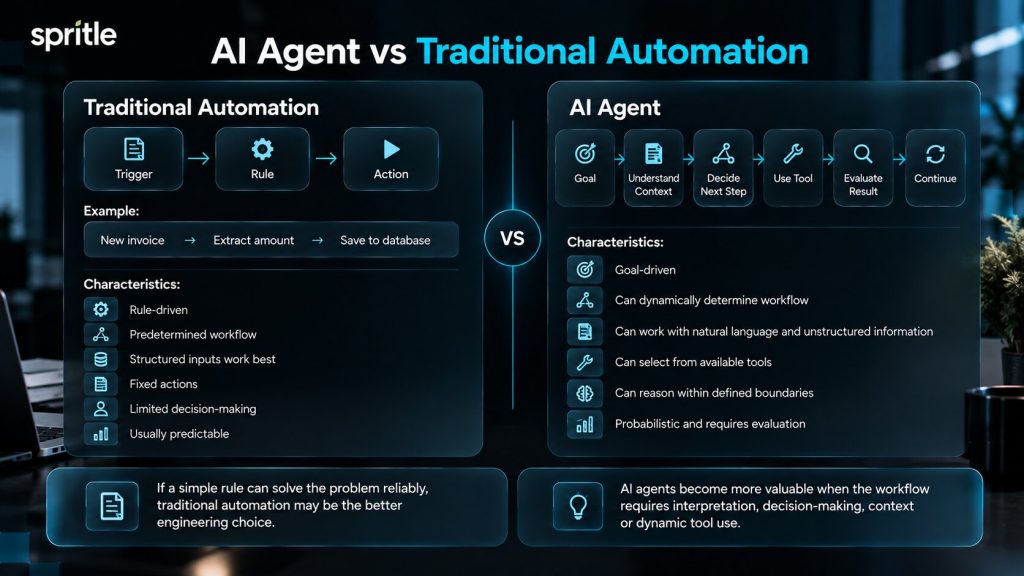
AI Agent vs Traditional Automation
AI agents are also different from conventional automation.
Traditional automation typically follows predefined rules:
Trigger → Rule → Action
For example:
New invoice → Extract amount → Save to database
An AI agent can operate with more flexibility:
Goal → Understand Context → Decide Next Step → Use Tool → Evaluate Result → Continue
This matters when workflows involve ambiguity, unstructured information or multiple possible paths.
| Traditional Automation | AI Agent |
| Rule-driven | Goal-driven |
| Predetermined workflow | Can dynamically determine workflow |
| Structured inputs work best | Can work with natural language and unstructured information |
| Fixed actions | Can select from available tools |
| Limited decision-making | Can reason within defined boundaries |
| Usually predictable | Probabilistic and requires evaluation |
However, AI agents should not replace deterministic automation everywhere.
If a simple rule can solve the problem reliably, traditional automation may be the better engineering choice.
AI agents become more valuable when the workflow requires interpretation, decision-making, context or dynamic tool use.
What Are the Core Components of an AI Agent?
An effective AI agent is more than an LLM connected to a chatbot interface.
A production agent typically combines several components.
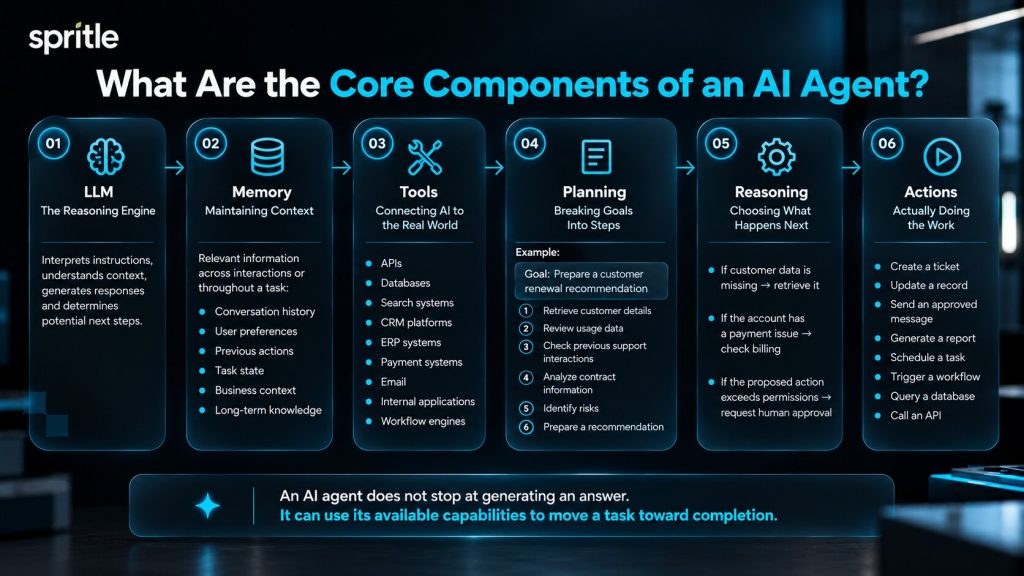
1. LLM – The Reasoning Engine
A large language model can interpret instructions, understand context, generate responses and determine potential next steps.
But the LLM alone cannot usually access your enterprise systems or perform real-world actions.
That requires the rest of the agent architecture.
2. Memory – Maintaining Context
Memory allows an agent to retain relevant information across interactions or throughout a task.
Depending on the application, this may include:
- Conversation history
- User preferences
- Previous actions
- Task state
- Business context
- Long-term knowledge
Memory should be designed carefully.
An agent should not automatically remember everything.
It needs relevant, secure and controlled context.
3. Tools – Connecting AI to the Real World
Tools allow an AI agent to interact with external systems.
Examples include:
- APIs
- Databases
- Search systems
- CRM platforms
- ERP systems
- Payment systems
- Internal applications
- Workflow engines
This is one of the biggest differences between a basic LLM application and an AI agent.
The model can decide:
“I need to check the CRM.”
The agent architecture provides the actual tool that allows it to do so.
4. Planning – Breaking Goals Into Steps
Complex tasks often cannot be solved in one model response.
An agent may need to break a goal into smaller actions.
For example:
Goal: Prepare a customer renewal recommendation.
The agent might determine:
- Retrieve customer details
- Review usage data
- Check previous support interactions
- Analyze contract information
- Identify risks
- Prepare a recommendation
Planning turns a broad objective into an executable workflow.
5. Reasoning – Choosing What Happens Next
The agent needs to determine which action makes sense based on the current state.
For example:
If customer data is missing → retrieve it.
If the account has a payment issue → check billing.
If the proposed action exceeds permissions → request human approval.
The agent therefore needs both intelligence and boundaries.
6. Actions – Actually Doing the Work
The final step is action.
An agent may:
- Create a ticket
- Update a record
- Send an approved message
- Generate a report
- Schedule a task
- Trigger a workflow
- Query a database
- Call an API
The important distinction is:
An AI agent does not stop at generating an answer. It can use its available capabilities to move a task toward completion.
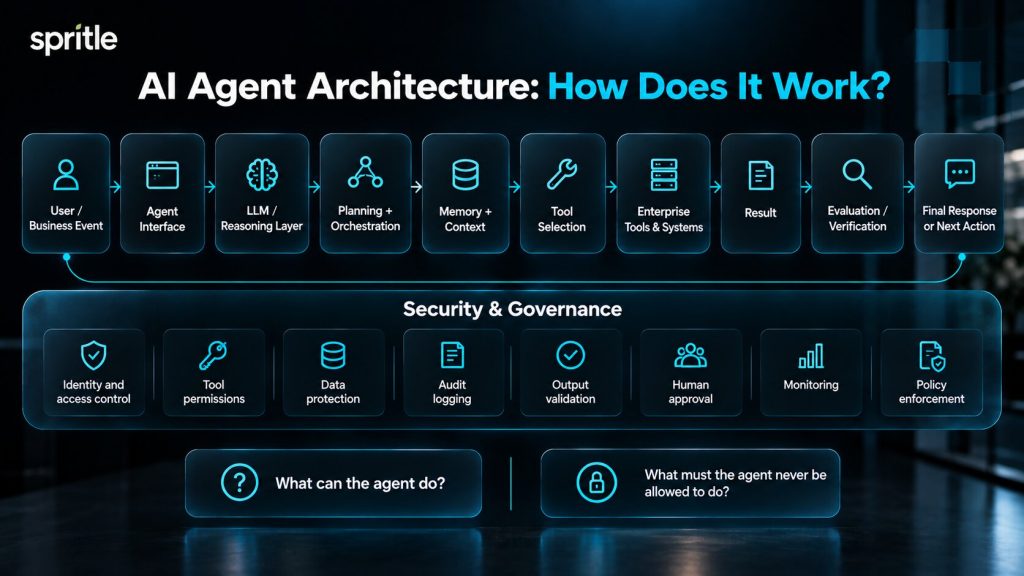
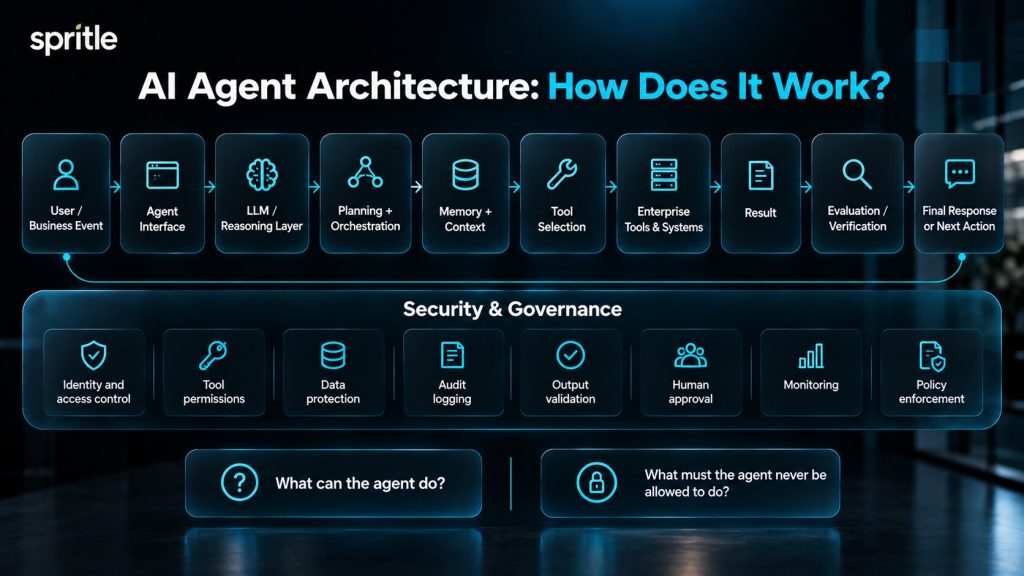
AI Agent Architecture: How Does It Work?
A practical enterprise agent architecture can be represented as:
User / Business Event
↓
Agent Interface
↓
LLM / Reasoning Layer
↓
Planning + Orchestration
↓
Memory + Context
↓
Tool Selection
↓
Enterprise Tools & Systems
↓
Result
↓
Evaluation / Verification
↓
Final Response or Next Action
Security and governance should operate across the entire architecture.
For enterprise environments, this can include:
- Identity and access control
- Tool permissions
- Data protection
- Audit logging
- Output validation
- Human approval
- Monitoring
- Policy enforcement
The architecture therefore needs to answer two questions:
“What can the agent do?”
and equally importantly:
“What must the agent never be allowed to do?”
How Does AI Agent Engineering Work?
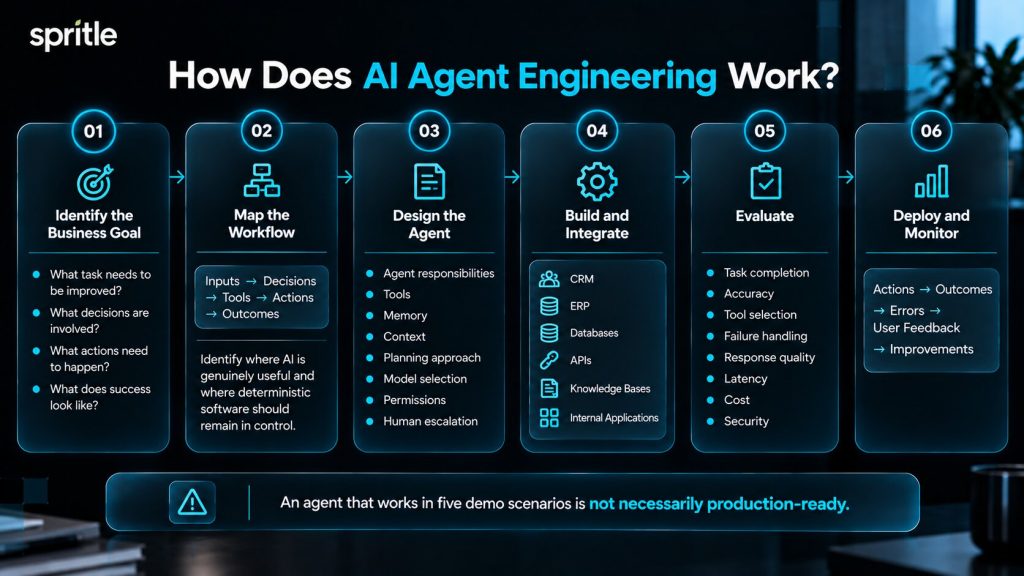
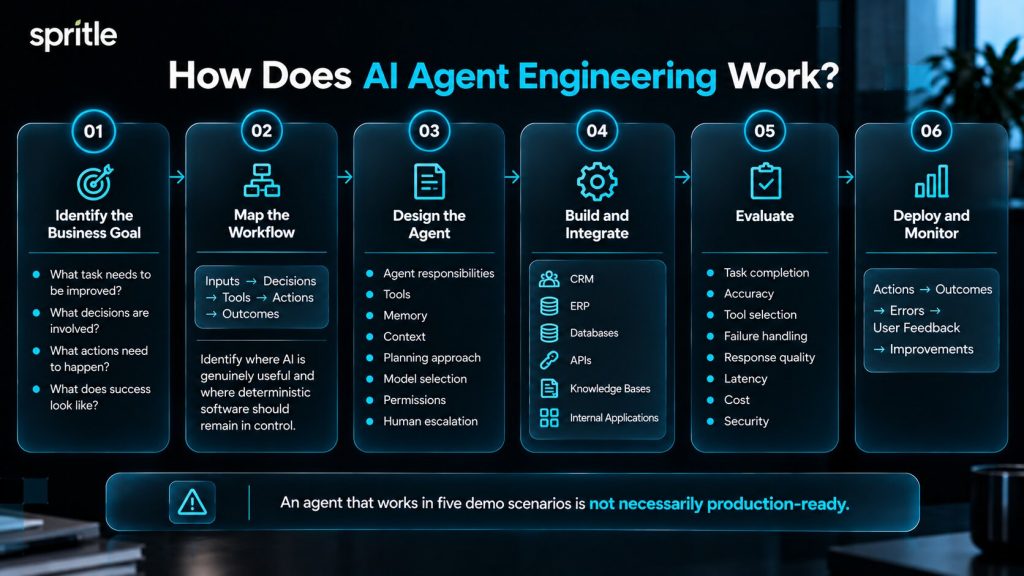
Building an agent is not simply connecting an LLM to an API.
A robust AI Agent Engineering lifecycle typically includes the following stages.
1. Identify the Business Goal
Start with the workflow, not the technology.
Define:
- What task needs to be improved?
- What decisions are involved?
- What actions need to happen?
- What does success look like?
2. Map the Workflow
Break the process into:
Inputs → Decisions → Tools → Actions → Outcomes
Identify where AI is genuinely useful and where deterministic software should remain in control.
3. Design the Agent
Define:
- Agent responsibilities
- Tools
- Memory
- Context
- Planning approach
- Model selection
- Permissions
- Human escalation
4. Build and Integrate
Connect the agent with the systems it needs to use.
This could include:
CRM + ERP + Databases + APIs + Knowledge Bases + Internal Applications
-
Evaluate
Test the agent against realistic scenarios.
Evaluate:
- Task completion
- Accuracy
- Tool selection
- Failure handling
- Response quality
- Latency
- Cost
- Security
An agent that works in five demo scenarios is not necessarily production-ready.
6. Deploy and Monitor
Once deployed, continuously monitor how the agent behaves.
Track:
Actions → Outcomes → Errors → User Feedback → Improvements
This creates the foundation for reliable enterprise-scale agent systems.
Enterprise AI Agent Use Cases
AI agents become especially useful when a business process involves multiple systems, decisions and actions.
Customer Service Agents
Agents can retrieve customer information, understand support requests, investigate issues and execute approved service workflows.
IT Service Agents
An agent can classify incidents, retrieve troubleshooting information, investigate system status and initiate approved remediation workflows.
Sales Agents
Sales agents can research accounts, summarize interactions, identify opportunities and prepare follow-up actions.
Finance Agents
Agents can assist with invoice analysis, reconciliation, financial reporting and exception handling.
HR Agents
AI agents can help employees find policies, answer questions, initiate HR workflows and retrieve relevant information.
Software Engineering Agents
Coding agents can inspect repositories, generate code, run tests, analyze failures and assist developers across multi-step engineering tasks.
Operations Agents
Agents can monitor business workflows, identify exceptions and recommend or execute predefined actions.
The strongest use cases usually have three characteristics:
High information volume + multiple steps + measurable business outcomes.
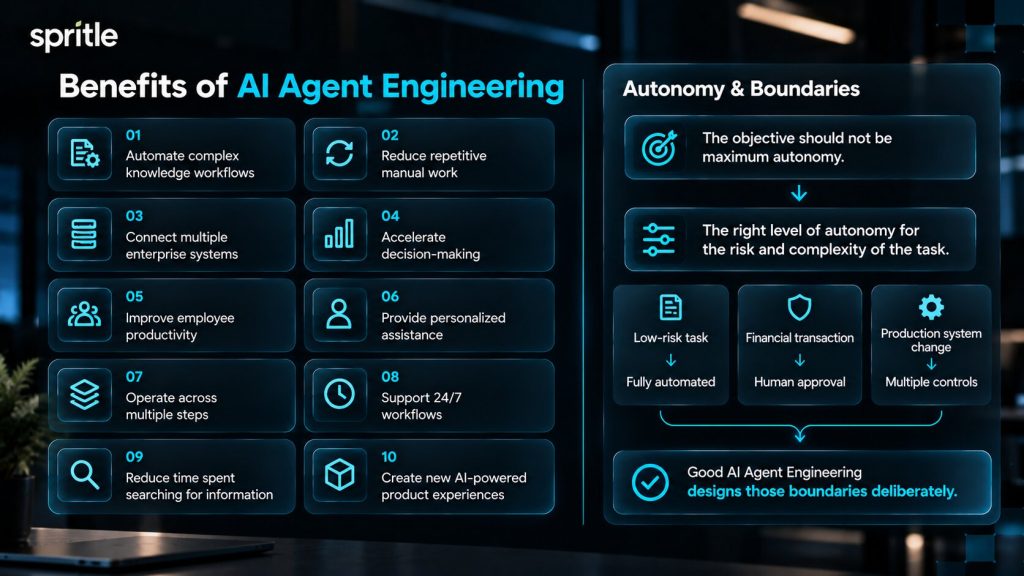
Benefits of AI Agent Engineering
Well-designed AI agents can help enterprises:
- Automate complex knowledge workflows
- Reduce repetitive manual work
- Connect multiple enterprise systems
- Accelerate decision-making
- Improve employee productivity
- Provide personalized assistance
- Operate across multiple steps
- Support 24/7 workflows
- Reduce time spent searching for information
- Create new AI-powered product experiences
But the objective should not be maximum autonomy.
The objective should be:
The right level of autonomy for the risk and complexity of the task.
A low-risk task might be fully automated.
A financial transaction may require human approval.
A production system change may require multiple controls.
Good AI Agent Engineering designs those boundaries deliberately.
What Are the Challenges of AI Agent Engineering?
Unpredictable Behaviour
LLMs can produce unexpected outputs, so agents require evaluation and guardrails.
Tool Misuse
An agent may select an inappropriate tool or provide incorrect parameters.
Tool permissions and validation are therefore critical.
Context Management
Too little context can produce poor decisions.
Too much context can increase cost, latency and confusion.
Security
Agents can potentially access sensitive information or perform consequential actions.
Identity, authorization and least-privilege access are essential.
Reliability
An agent may encounter API failures, incomplete information or unexpected system states.
Production agents therefore need error handling and recovery strategies.
Cost and Latency
Multiple model calls and tool interactions can increase both inference costs and response time.
Evaluation
Traditional software tests alone cannot fully evaluate agent behavior.
Testing needs to include realistic scenarios and task-level outcomes.
Should Every Business Use AI Agents?
No.
This is an important point that gets overlooked in AI discussions.
If a process can be solved reliably with:
If X → Do Y
then traditional automation may be cheaper, faster and easier to control.
AI agents are more appropriate when the workflow involves:
- Unstructured information
- Ambiguous requests
- Multiple possible paths
- Contextual decisions
- Natural-language interaction
- Multiple tools
- Multi-step reasoning
The best enterprise architecture may actually combine both.
Deterministic automation for predictable tasks + AI agents for complex decision-oriented tasks.
That hybrid approach can provide greater control without sacrificing flexibility.
AI Agent Engineering: From Chatbots to Action-Oriented AI
The evolution of enterprise AI can be viewed as:
Rules → Automation → Chatbots → AI Assistants → AI Agents → Multi-Agent Systems
Each stage increases the system’s ability to interpret context and perform work.
But increased autonomy also increases engineering responsibility.
The moment an AI system can take action, questions about permissions, verification, observability, security and accountability become just as important as model intelligence.
That is why AI Agent Engineering should be treated as a software engineering discipline rather than simply prompt engineering.
The Future of AI Agent Engineering
The next generation of enterprise applications will increasingly combine:
AI + Data + Tools + Workflows + Human Oversight
Agents may become interfaces through which employees interact with complex enterprise systems.
Instead of opening five applications to complete a task, an employee may describe the desired outcome and allow an agent to coordinate the underlying systems.
But successful enterprise adoption will depend on something more fundamental than better models.
It will depend on building agents that are:
Useful. Reliable. Secure. Observable. Controllable.
That is the real engineering challenge.
The future of AI agents is not about making AI act without humans. It is about designing systems that know what they can do, when they should act, and when they should ask for help.
Frequently Asked Questions
What is AI Agent Engineering?
AI Agent Engineering is the process of designing and building AI agents that can understand goals, reason through tasks, use tools, access information and take actions within defined boundaries.
What is the difference between an AI agent and a chatbot?
A chatbot primarily generates conversational responses. An AI agent can pursue a goal, plan multiple steps, use tools and take actions to complete a task.
What is the difference between AI agents and traditional automation?
Traditional automation follows predefined rules and workflows. AI agents can interpret context, make decisions and dynamically determine which tools or actions to use.
What are the main components of an AI agent?
Core components typically include an LLM, memory, context, tools, planning, reasoning, orchestration, actions and evaluation. Production systems also require security, monitoring and governance.
Can AI agents work with enterprise systems?
Yes. AI agents can integrate with enterprise applications through APIs, databases, workflow engines and other approved tools, subject to appropriate authentication and authorization controls.
Are AI agents fully autonomous?
Not necessarily. Agents can operate with different levels of autonomy. High-risk actions can require human approval while low-risk tasks can be automated.
What are the biggest challenges of AI agent engineering?
Major challenges include reliability, tool selection, security, context management, evaluation, cost, latency and controlling agent actions.
When should a company use an AI agent?
AI agents are most useful for complex, multi-step workflows involving unstructured information, contextual decisions, multiple systems or actions that cannot easily be represented through fixed rules.
Post Comment
Tik prisijungę vartotojai gali komentuoti.