What Is AI Native Product Engineering? A Complete Guide
AI is no longer just a feature you add to software. In a growing class of products, AI is becoming the foundation the entire product is built around.
That changes almost everything.
The architecture changes. The user experience changes. Data becomes an active product layer. Software needs to handle probabilistic outputs. Agents can perform actions instead of simply displaying information. And the product itself may improve as models, data and user feedback evolve.
This is the idea behind AI Native Product Engineering.
An AI-native product is designed around AI from the beginning rather than taking conventional software and adding an AI feature later. IBM similarly describes AI-native systems as products designed from the ground up with AI as a core component that shapes architecture, decision-making, user experience and the system lifecycle.
But what does that actually mean for product engineering?


What Is AI Native Product Engineering?
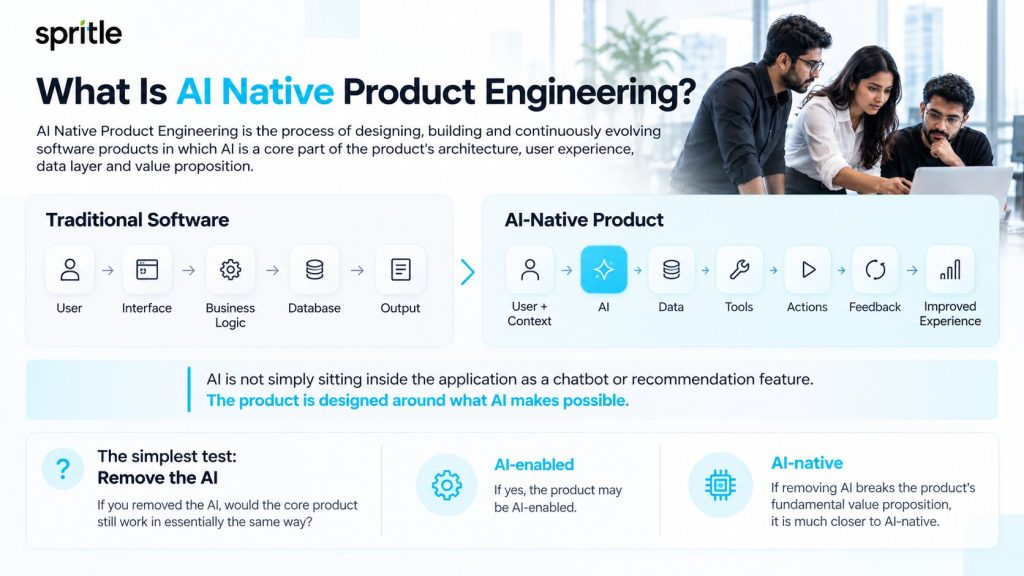
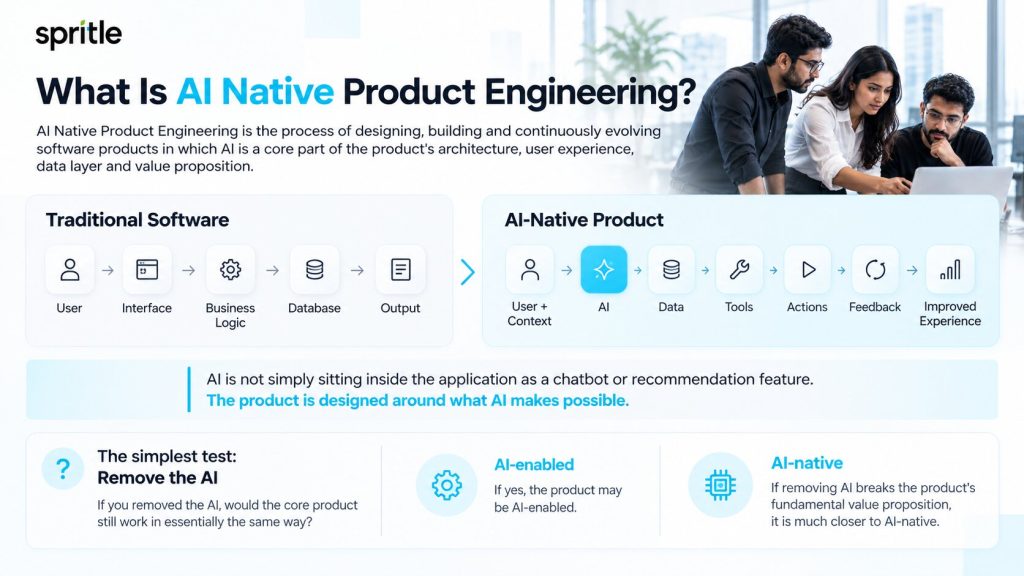
AI Native Product Engineering is the process of designing, building and continuously evolving software products in which AI is a core part of the product’s architecture, user experience, data layer and value proposition.
In traditional software, the application usually follows predefined rules:
User → Interface → Business Logic → Database → Output
An AI-native product introduces an intelligence layer into that system:
User + Context → AI → Data → Tools → Actions → Feedback → Improved Experience
The difference is fundamental.
AI is not simply sitting inside the application as a chatbot or recommendation feature.
The product is designed around what AI makes possible.
The simplest test: Remove the AI
Ask one question:
If you removed the AI, would the core product still work in essentially the same way?
If yes, the product may be AI-enabled.
If removing AI breaks the product’s fundamental value proposition, it is much closer to AI-native.
This “remove the AI” test is also used in current discussions of AI-native products to distinguish AI as a core architectural foundation from AI as an enhancement.
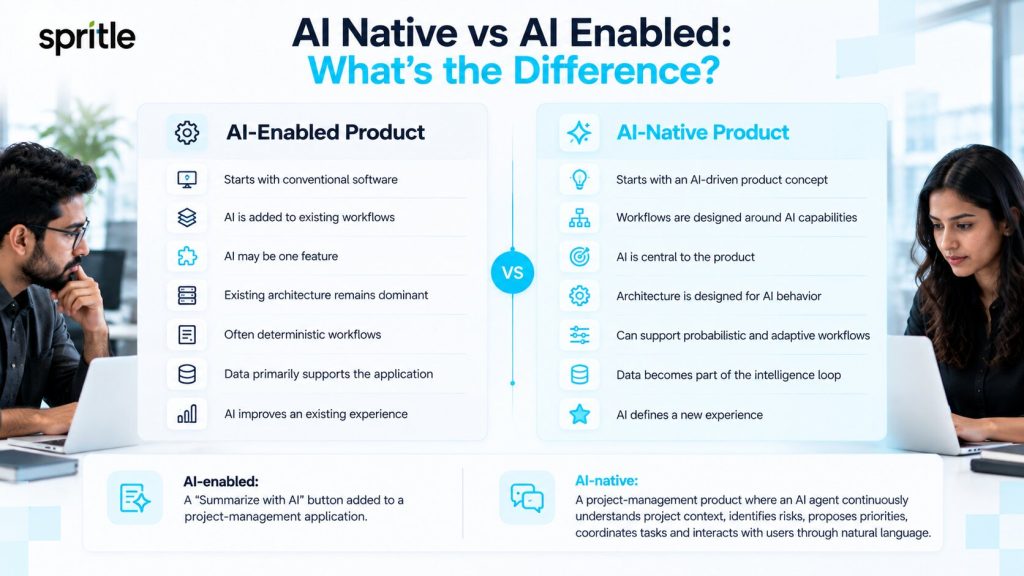
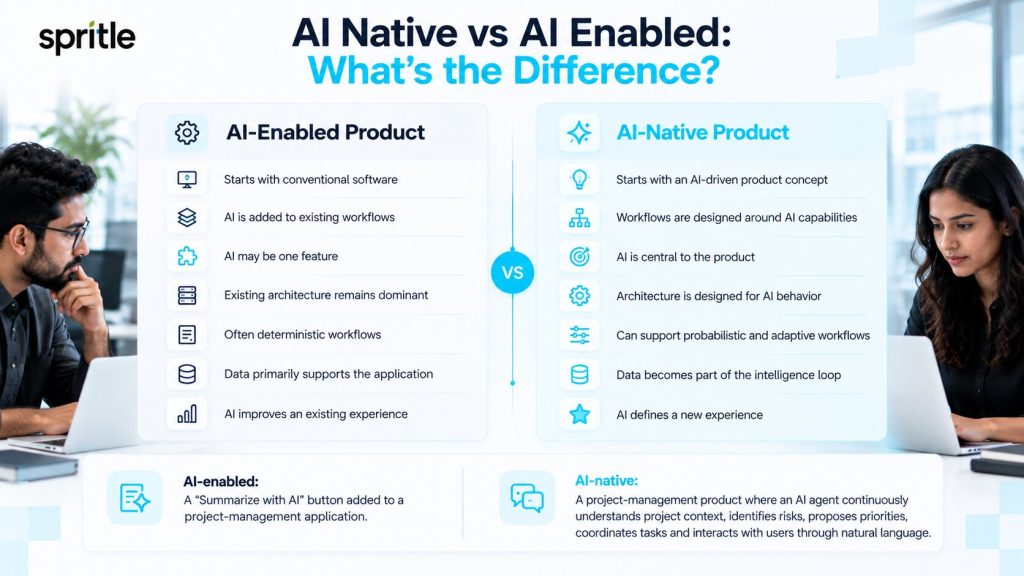
AI Native vs AI Enabled: What’s the Difference?
The terms sound similar, but they represent two different product strategies.
| AI-Enabled Product | AI-Native Product |
| Starts with conventional software | Starts with an AI-driven product concept |
| AI is added to existing workflows | Workflows are designed around AI capabilities |
| AI may be one feature | AI is central to the product |
| Existing architecture remains dominant | Architecture is designed for AI behavior |
| Often deterministic workflows | Can support probabilistic and adaptive workflows |
| Data primarily supports the application | Data becomes part of the intelligence loop |
| AI improves an existing experience | AI defines a new experience |
For example, adding a “Summarize with AI” button to a project-management application is generally AI-enabled.
A project-management product where an AI agent continuously understands project context, identifies risks, proposes priorities, coordinates tasks and interacts with users through natural language is much closer to AI-native product engineering.
AI Native vs Traditional Software: What Changes?
Traditional software is built around explicit rules.
If condition A occurs, execute action B.
That model works extremely well for predictable processes.
But AI introduces capabilities such as:
- Natural-language interaction
- Pattern recognition
- Prediction
- Generation
- Reasoning
- Personalization
- Recommendation
- Tool use
- Autonomous task execution
This means product teams can design experiences that were difficult or impractical with conventional software.
Consider a traditional expense management application.
A traditional system might allow employees to upload receipts, enter information and submit expenses.
An AI-native product could interpret the receipt, understand the expense context, detect anomalies, categorize the transaction, check company policy, ask the employee for missing information and prepare the submission automatically.
The product isn’t simply processing information faster.
It is participating in the workflow.
That is the architectural shift at the heart of AI Native Product Engineering.
What Makes a Product AI Native?
There is no single checklist that makes a product AI-native, but several characteristics consistently appear.
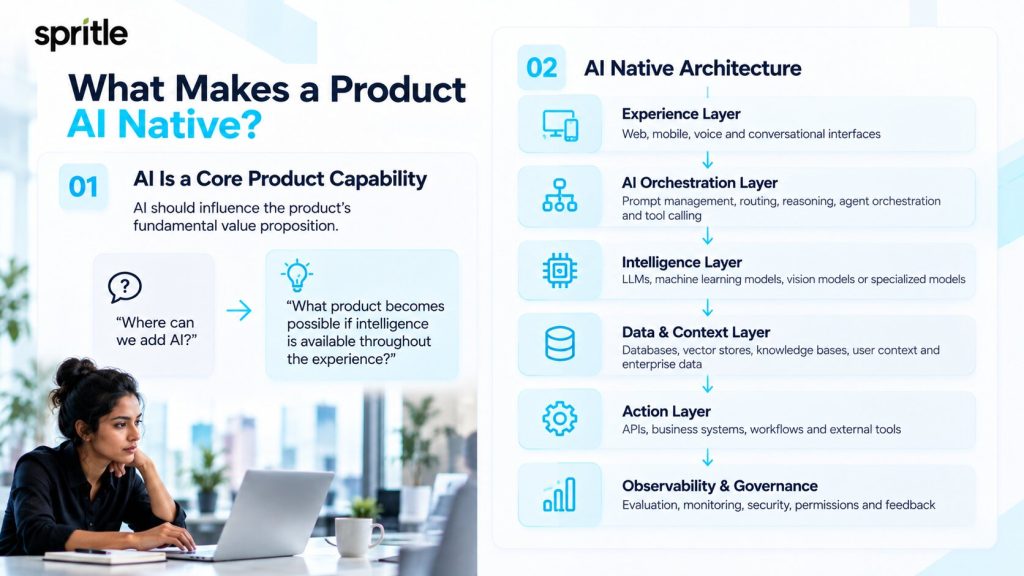
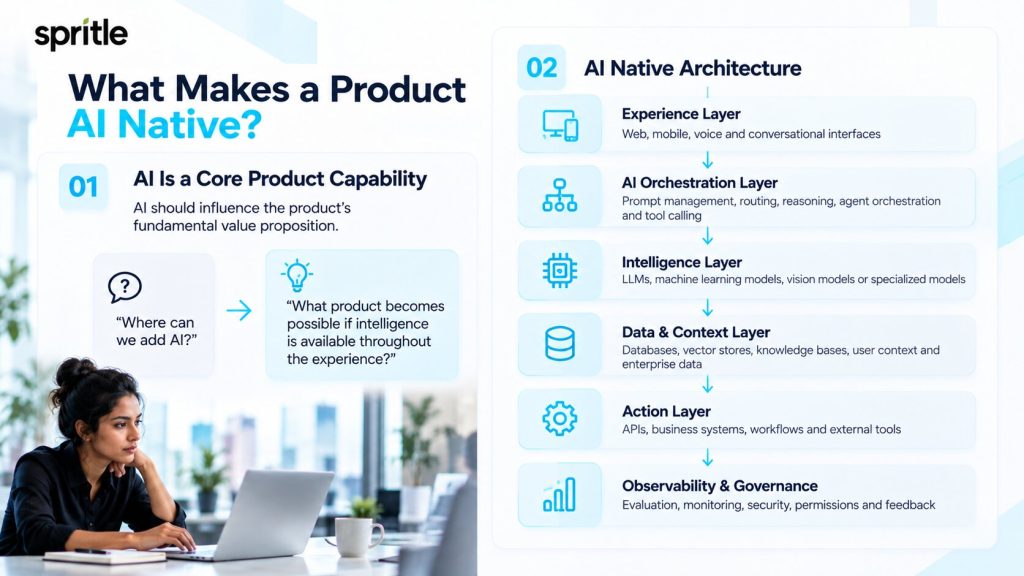
1. AI Is a Core Product Capability
AI should influence the product’s fundamental value proposition.
Instead of asking:
“Where can we add AI?”
the product team asks:
“What product becomes possible if intelligence is available throughout the experience?”
That question often leads to completely different product concepts.
2. AI Native Architecture
An AI-native architecture treats AI as a first-class system component rather than a model API hidden inside an existing backend.
A typical architecture can include:
Experience Layer
Web, mobile, voice and conversational interfaces
↓
AI Orchestration Layer
Prompt management, routing, reasoning, agent orchestration and tool calling
↓
Intelligence Layer
LLMs, machine learning models, vision models or specialized models
↓
Data & Context Layer
Databases, vector stores, knowledge bases, user context and enterprise data
↓
Action Layer
APIs, business systems, workflows and external tools
↓
Observability & Governance
Evaluation, monitoring, security, permissions and feedback
Modern agent-native architecture discussions similarly emphasize shared actions, data, permissions and context so that humans and AI agents can operate within the same product model.
The Role of LLMs in AI Native Product Engineering
Large language models, or LLMs, are an important building block for many AI-native products.
They can provide capabilities such as:
- Natural-language understanding
- Content generation
- Reasoning
- Classification
- Summarization
- Conversational interaction
- Tool selection
But an AI-native product is not simply an LLM wrapper.
The LLM is one component within a larger system.
A production product may need:
LLM + Context + Data + Tools + Memory + Guardrails + Evaluation + UX
That distinction is important.
Calling an LLM API can take minutes.
Engineering a dependable product around an LLM requires product, architecture, data and operational decisions.
AI Agents Are Changing Product Architecture
One of the biggest developments in AI Native Product Engineering is the move from AI that responds to AI that acts.
A chatbot might answer:
“Your order is delayed.”
An AI agent could potentially:
- Check the order system
- Identify the delay
- Review available inventory
- Contact an approved logistics API
- Recommend an alternative
- Ask the customer for approval
- Update the order
The product therefore needs more than a conversational interface.
It needs:
- Tool calling
- Permissions
- State management
- Context
- Memory
- Error handling
- Human approval
- Observability
- Recovery mechanisms
This is why agentic products require architectural thinking around actions and boundaries rather than simply adding a chat window.
The Data Layer Becomes Part of the Product
In conventional applications, data primarily supports transactions.
In an AI-native product, data can also provide the context and feedback that make intelligence useful.
The data layer may include:
- Structured databases
- Unstructured documents
- Vector databases
- Knowledge graphs
- User behavior
- Conversation history
- Product telemetry
- External APIs
- Real-time events
For example, an AI-powered enterprise knowledge product becomes more valuable when it can securely retrieve relevant organizational information rather than relying only on the model’s general knowledge.
This makes data architecture a core part of AI Native Product Engineering, not simply a backend concern.
AI UX: Designing for Probabilistic Software
Traditional UX assumes that the system behaves predictably.
AI does not always work that way.
An AI response can be:
- Correct
- Partially correct
- Ambiguous
- Incomplete
- Unexpected
- Confident but wrong
AI-native UX therefore needs to communicate uncertainty and provide users with appropriate control.
Useful patterns can include:
- Suggested actions
- Editable AI outputs
- Citations or source references
- Confidence indicators
- Approval steps
- Undo and recovery
- Human handoffs
- Feedback controls
- Conversation history
The interface should answer an important question:
“What can the AI do, and what happens when it gets something wrong?”
That is product design, not just model engineering.
Continuous Learning: Does an AI Native Product Keep Improving?
An AI-native product can be designed with feedback loops that help teams continuously improve its behavior.
The loop can look like:
User Interaction → Product Telemetry → Evaluation → Feedback → Data/Prompt/Model Improvement → Better Experience
Continuous improvement does not necessarily mean automatically retraining a model after every user interaction.
It can involve:
- Prompt optimization
- Retrieval improvement
- Better evaluation datasets
- Model routing
- Fine-tuning
- Workflow changes
- UI improvements
- Guardrail updates
The important idea is that the product is engineered to learn from its operation.
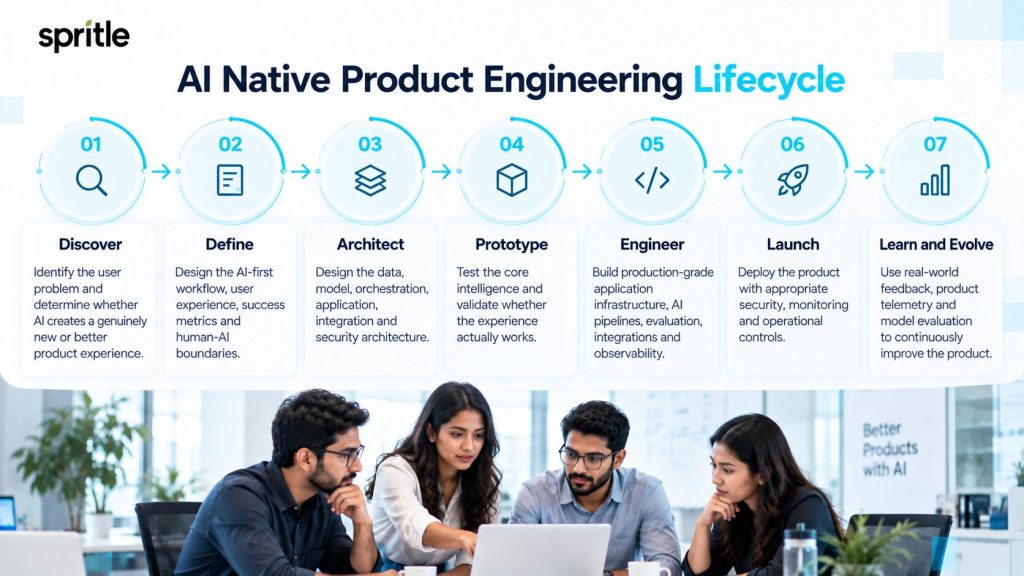
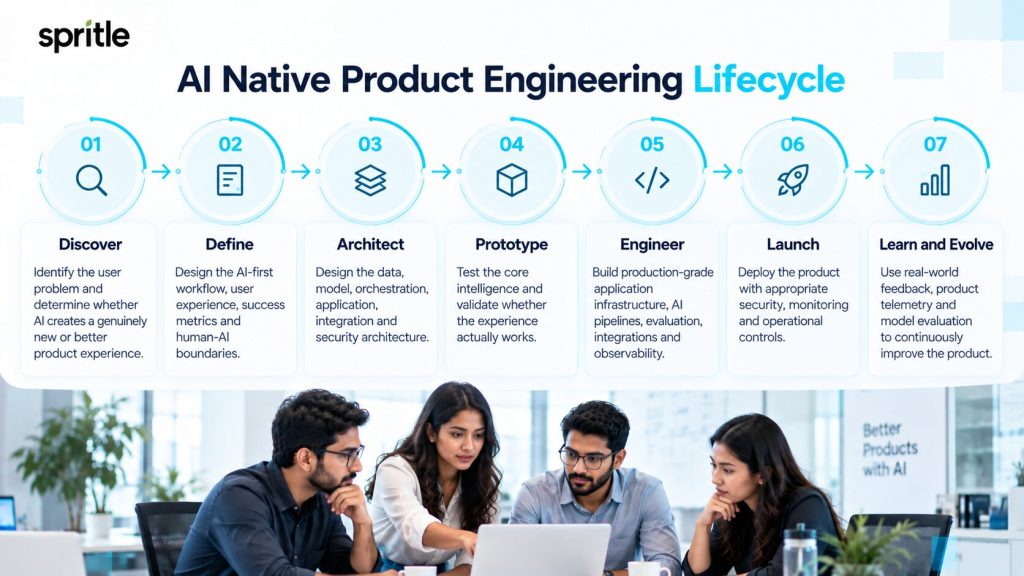
AI Native Product Engineering Lifecycle
Building an AI-native product requires a different development approach from conventional software.
1. Discover
Identify the user problem and determine whether AI creates a genuinely new or better product experience.
2. Define
Design the AI-first workflow, user experience, success metrics and human-AI boundaries.
3. Architect
Design the data, model, orchestration, application, integration and security architecture.
4. Prototype
Test the core intelligence and validate whether the experience actually works.
5. Engineer
Build production-grade application infrastructure, AI pipelines, evaluation, integrations and observability.
6. Launch
Deploy the product with appropriate security, monitoring and operational controls.
7. Learn and Evolve
Use real-world feedback, product telemetry and model evaluation to continuously improve the product.
Examples of AI Native Products
AI-native approaches can be applied across many product categories.
AI-Native Customer Support
Instead of simply displaying support tickets, the product understands customer intent, retrieves context, recommends solutions and can execute approved actions.
AI-Native Knowledge Platforms
Users ask questions naturally while the system retrieves relevant enterprise information, synthesizes answers and maintains contextual interactions.
AI-Native Developer Tools
The product understands codebases, development context and developer intent rather than simply offering isolated autocomplete.
AI-Native Healthcare Platforms
AI can assist with clinical information retrieval, documentation, decision support and workflow coordination while maintaining appropriate human oversight.
AI-Native Operations Platforms
AI agents can monitor workflows, identify exceptions and recommend or execute actions within defined boundaries.
The common thread is simple:
AI is part of how the product works, not merely something the product contains.
Benefits of AI Native Product Engineering
A well-designed AI-native product can provide several advantages:
- More natural user experiences
- Greater personalization
- Intelligent automation
- Faster decision support
- New product capabilities
- Reduced manual interaction
- Context-aware workflows
- More adaptive software
- Opportunities for continuous product improvement
It can also create a stronger product moat when proprietary workflows, data, feedback loops and domain-specific intelligence accumulate over time.
But AI-native does not automatically mean better.
The architecture must still be justified by the problem.
What Are the Challenges of AI Native Product Engineering?
AI-native products introduce challenges that traditional software teams may not encounter as deeply.
Non-Deterministic Behaviour
The same input may not always produce identical output.
Model Dependency
Foundation models change quickly, which can affect cost, quality and behavior.
Evaluation
Traditional unit tests are not enough for many AI behaviors. Teams need systematic evaluation.
Cost and Latency
Frequent model calls can introduce both infrastructure cost and response-time challenges.
Security
AI systems introduce risks involving prompts, data access, model outputs and tool execution.
User Trust
Users need to understand when AI is making a recommendation, generating information or taking action.
Product Ownership
AI behavior sits at the intersection of product, engineering, data and model operations.
This is why AI Native Product Engineering requires cross-functional thinking rather than treating AI as an isolated development task.
When Should You Build an AI Native Product?
AI-native architecture makes the most sense when AI is central to the product’s value.
Consider it when:
- Natural-language interaction is fundamental
- Personalization is core to the product
- Intelligent automation is central to the workflow
- AI agents need to perform meaningful actions
- The product depends on continuous learning
- Context and reasoning create significant product value
- The product would fundamentally change without AI
If AI is only being used for a small enhancement, a conventional architecture with an AI capability may be more practical.
Not every AI product needs to be AI-native.
The goal is to choose the architecture that matches the product.
AI Native Product Engineering: The Bigger Shift
The most important change is not that software now contains AI.
It is that AI changes what software can be designed to do.
Traditional software largely waits for users to provide instructions.
AI-native software can understand intent, work with context, generate possibilities, recommend decisions, use tools and participate in workflows.
That changes the role of product engineering.
Teams are no longer designing only screens, APIs and business rules.
They are designing intelligence, context, actions, feedback loops and boundaries.
And that is the real meaning of AI Native Product Engineering.
AI-native products don’t simply add intelligence to software. They rethink the product around intelligence from the beginning.
For organizations exploring an AI-native product, the first step is not necessarily choosing an LLM.
It is identifying what becomes possible when intelligence is treated as a core product capability.
Frequently Asked Questions
What is AI Native Product Engineering?
AI Native Product Engineering is the process of building software products where AI is a core part of the architecture, user experience, data layer and product value proposition rather than an add-on feature.
What is the difference between AI-native and AI-enabled?
An AI-enabled product adds AI capabilities to an existing software product. An AI-native product is designed around AI from the beginning, making intelligence central to how the product delivers value.
What technologies are used in AI-native products?
Depending on the use case, an AI-native product may use LLMs, machine learning, RAG, AI agents, vector databases, orchestration frameworks, APIs, cloud infrastructure, evaluation systems and observability platforms.
Do AI-native products always require AI agents?
No. AI agents are useful when products need AI to plan, use tools or execute multi-step tasks. An AI-native product can also be built around LLMs, prediction, recommendations, computer vision or other AI capabilities.
How is AI-native architecture different from traditional software architecture?
AI-native architecture treats models, context, data, orchestration, evaluation and probabilistic behavior as first-class architectural concerns rather than treating AI as an isolated API feature.
What are the main challenges of AI-native product development?
Major challenges include non-deterministic outputs, model changes, evaluation, latency, cost, data quality, security, user trust and designing effective human-AI interactions.
When should a company choose AI-native product engineering?
AI-native engineering is most appropriate when AI is central to the product’s value, such as intelligent automation, natural-language interaction, personalization, AI agents, decision support or continuously improving experiences.


Post Comment
Tik prisijungę vartotojai gali komentuoti.